
Ranking #1 on Google doesn’t guarantee visibility anymore, when someone asks ChatGPT or Google’s AI Overview a question, your page might get summarized, quoted, or skipped entirely without a single click. AI search optimization, often called GEO or Generative Engine Optimization, is the practice of getting your content cited and recommended inside these AI-generated answers, not just ranked in a list of blue links.
If you’ve read our technical SEO checklist or our post on Google AI marketing tools, this is the missing piece, how to actually get found inside the AI tools themselves, not just use them.
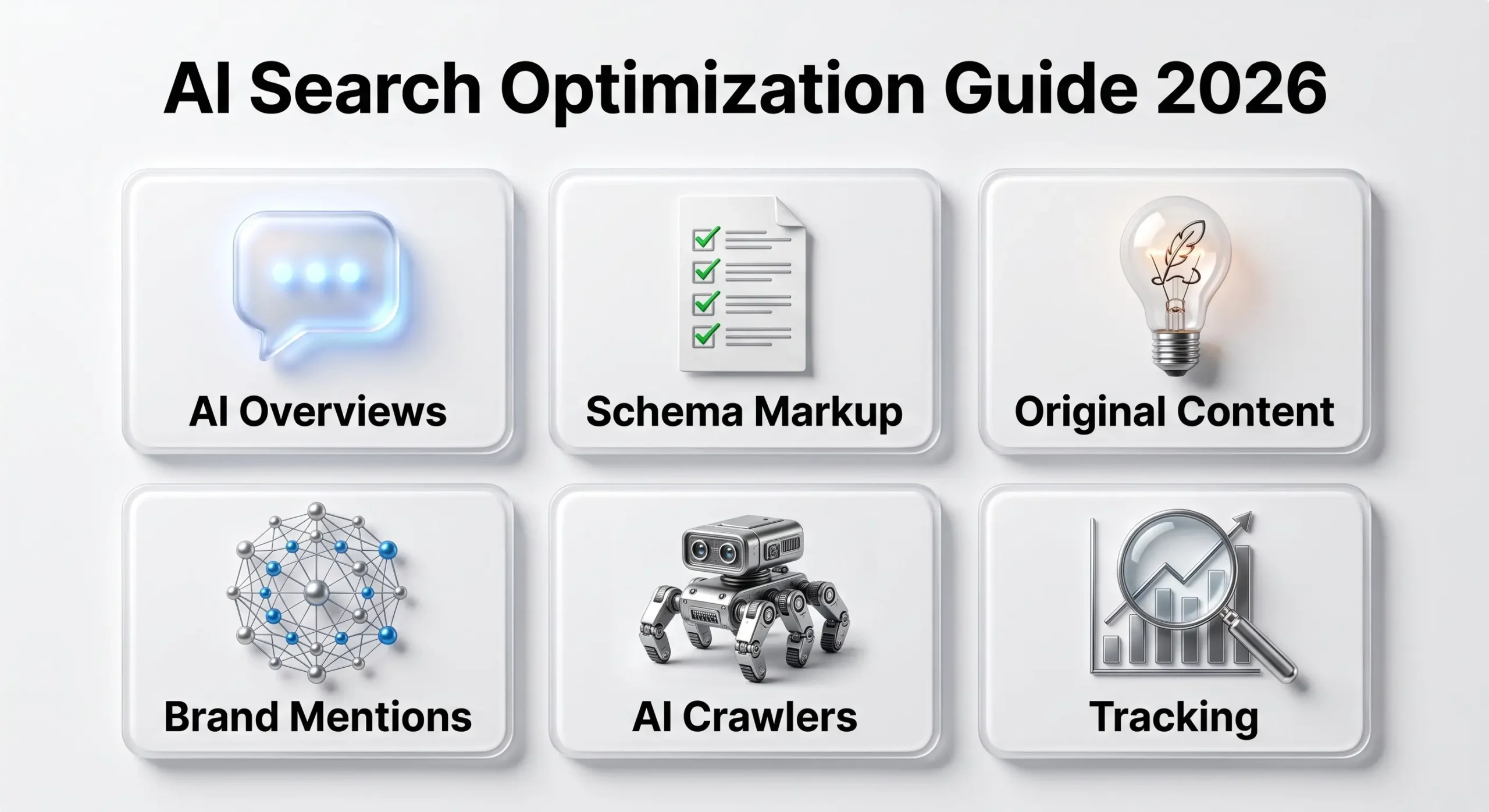
Why AI Search Optimization Matters Now
Google’s AI Overviews now appear on a large share of searches, answering the question directly above the traditional results, and tools like ChatGPT, Perplexity, and Claude are increasingly used as a starting point for research and buying decisions instead of a search engine.
Traditional SEO still matters, since these AI systems largely pull from the same indexed web content, but ranking well on Google no longer guarantees your business gets mentioned when someone asks an AI assistant instead.
1. Structure Content to Answer Questions Directly
AI systems extract and summarize content that answers a question clearly and quickly, dense, unstructured paragraphs are far harder for them to lift a clean answer from.
What to do: Open sections with a direct answer in the first sentence or two before expanding on it, use question-style headings that match how people actually ask AI assistants things, and keep answers self-contained so a single paragraph makes sense pulled out of context.
2. Structured Data Helps AI Understand Your Content
Schema markup doesn’t just help traditional rich results, it gives AI crawlers explicit signals about what your content is, who wrote it, and how trustworthy it is, reducing ambiguity that could get you left out of a summary.
What to do: Implement FAQ, HowTo, and Article schema where relevant, keep author and organization schema up to date to reinforce authority, and make sure your schema data matches the visible content exactly, mismatches can get content excluded entirely.
3. Original Data and First-Hand Experience Get Cited
AI systems favor content that adds something beyond what’s already been said elsewhere, generic rehashed advice is easy for them to summarize from anywhere, so it rarely gets your specific page cited.
What to do: Include original data, case studies, or specific numbers from your own business, share genuine first-hand experience rather than paraphrased generic advice, and update statistics and examples regularly so your content stays the freshest source on the topic.
4. Brand Mentions Across the Web Build AI Trust
AI systems appear to weigh how often and how consistently a brand or author is mentioned across the web, not just backlinks in the traditional SEO sense, when deciding what to trust and cite.
What to do: Get mentioned (even without a link) on relevant industry sites, forums, and review platforms, keep your business name and details consistent everywhere they appear, and build a genuine presence on platforms like Reddit and Quora where AI models are known to pull conversational, real-world answers from.
5. Making Sure AI Crawlers Can Actually Access Your Content
Some sites unintentionally block the very crawlers that power AI search tools, meaning even excellent content never gets a chance to be considered at all.
What to do: Check your robots.txt file to confirm you’re not accidentally blocking AI crawlers like GPTBot or Google-Extended if you want to be included, avoid gating your most valuable content entirely behind logins or paywalls, and keep core content in plain, crawlable HTML rather than relying only on JavaScript rendering.
6. Tracking Whether It’s Actually Working
AI search visibility doesn’t show up cleanly in traditional rank trackers, so measuring progress here takes a slightly different approach than checking a keyword’s position on Google.
What to do: Periodically ask ChatGPT, Perplexity, and Google’s AI Overview your target questions to see if and how you’re mentioned, watch for referral traffic from AI tools showing up in Google Analytics 4, and track branded search volume over time as a proxy for growing AI-driven awareness.
AI Search Optimization Checklist
Here’s the complete AI search optimization checklist for 2026, everything covered in this guide in one place:
- Answer questions directly in the first sentence of each section
- Implement accurate FAQ, HowTo, and Article schema
- Add original data and first-hand experience, not generic advice
- Build consistent brand mentions across forums and review sites
- Confirm AI crawlers like GPTBot aren’t blocked in robots.txt
- Manually check how AI tools answer your target questions
- Track branded search and AI referral traffic over time
Also read: Technical SEO Checklist for 2026
Also read: Google AI Digital Marketing Tools
The Bottom Line
AI search optimization for 2026 isn’t a replacement for SEO, it’s built on top of it, clear answer-first structure, accurate schema, original content, and genuine brand presence across the web, so AI tools have a real reason to cite you.
Start by checking how ChatGPT and Google’s AI Overview currently answer questions about your business or industry, then restructure your best-performing pages to answer those exact questions more directly.
Want to know where you stand? AmanTPoint helps small businesses audit and optimize their content for both traditional SEO and AI search visibility.


