
Brand building for small businesses isn’t about an expensive logo or a clever slogan. It’s about being the business a customer remembers, trusts, and picks over a similar competitor, even when the price is the same. Ads and SEO bring people to you, but your brand decides whether they stay, buy, and come back.
If you’ve read our content marketing strategy guide or our social media marketing strategy guide, this is the foundation underneath both, the identity and message every post, page, and ad is supposed to reinforce.
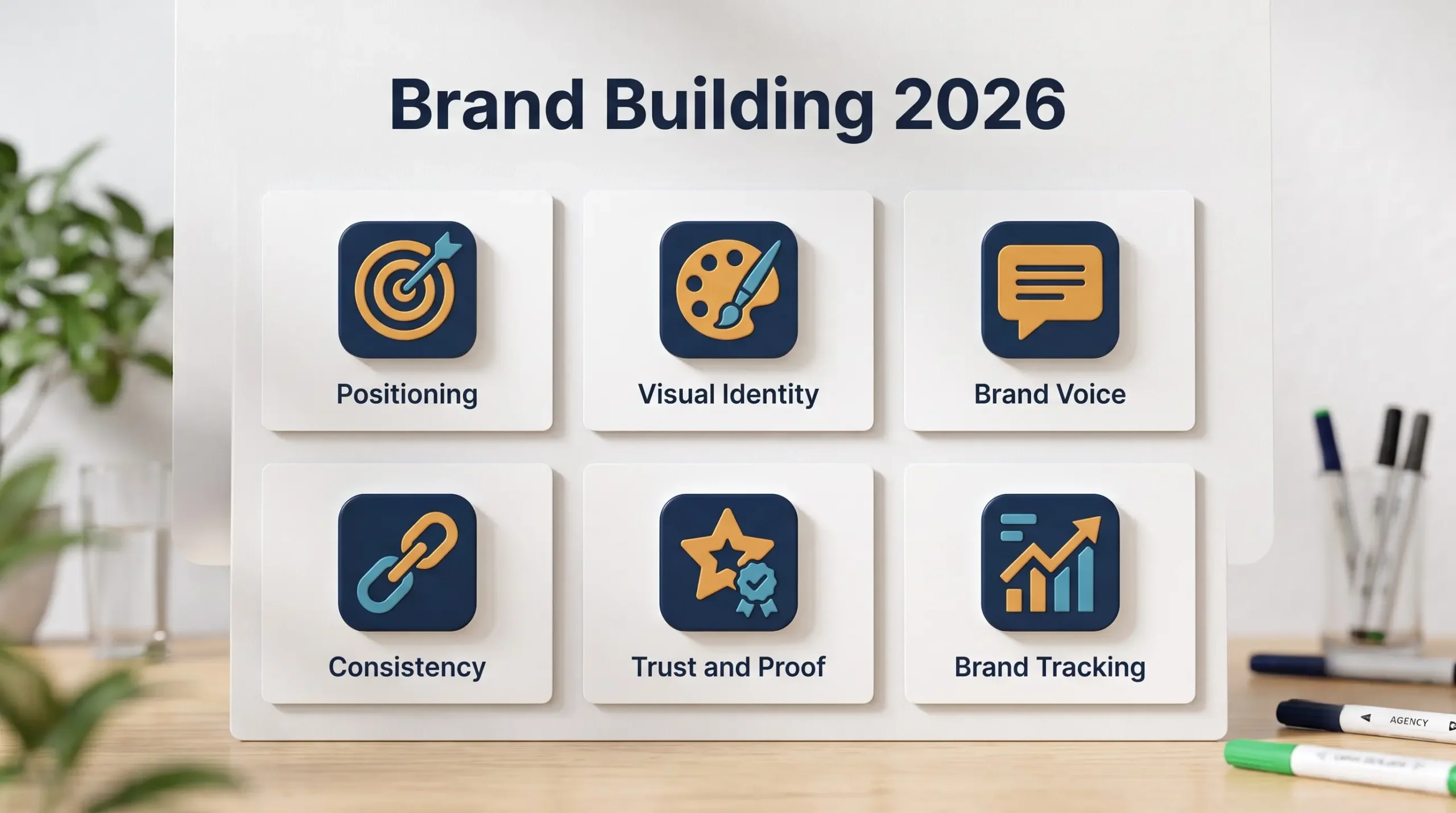
Why Brand Building for Small Businesses Pays Off
A recognizable brand makes every other channel work a little better. People click an ad from a name they know, trust a website that looks consistent, and are more willing to share their email or phone number with a business that feels real.
It also protects you from competing on price alone. When customers understand what makes you different, a slightly higher price becomes easier to justify.
1. Start With Who You Serve and What You Stand For
A brand that tries to appeal to everyone ends up memorable to no one. Clarity about your customer and your purpose comes before any design work.
What to do: Write down who your ideal customer is and what problem you solve for them, describe in one or two sentences why your business exists beyond making money, and list three values you’re willing to be judged on, such as fast response, honest pricing, or quality work.
2. Define Your Positioning Clearly
Positioning is the answer to a simple question: why should someone choose you instead of the other options? If you can’t answer it in a sentence, your customers can’t either.
What to do: Look at three direct competitors and note what they all say, then choose a point of difference you can honestly prove, such as speciality, speed, service quality, or local expertise. Turn it into a single clear statement and use it consistently across your website, profiles, and ads.
3. Build a Simple, Consistent Visual Identity
You don’t need a big design budget, but you do need consistency. A plain, consistent look builds recognition faster than an impressive one that changes every few months.
What to do: Choose one logo, two or three brand colors, and one or two fonts, and write them down in a one-page brand sheet, use the same profile photo, banner style, and color palette on your website and every social account, and keep image styles consistent so your content is recognizable even before someone reads the name.
4. Find Your Brand Voice
Your voice is how your brand sounds in writing: friendly or formal, playful or serious. A consistent voice makes your emails, posts, and web pages feel like they come from one real business.
What to do: Pick three words that describe how you want to sound (for example “warm, clear, practical”), write a few example sentences in that style, and use them as a reference when anyone on your team writes for the business. Avoid copying the tone of big brands that don’t match your actual customers.
5. Stay Consistent Across Every Channel
Customers often meet your brand in several places before they buy: a Google listing, a social post, an email, then your website. If each one looks and sounds different, trust drops.
What to do: Use the exact same business name, address, phone number, and description everywhere, including your Google Business Profile, social accounts, and directories. Keep your website and email marketing visually aligned, and consider adding Organization schema so search engines can connect your brand details correctly, as described in Google’s Organization structured data documentation.
6. Build Trust With Proof, Not Promises
Anyone can write “trusted and professional” on a website. Customers believe evidence far more than adjectives, especially for a business they’ve never heard of.
What to do: Show real customer reviews and short case studies with specific results, put real faces and names on your About page and in your content, and share behind-the-scenes content that shows how you actually work. Creators can also extend your reach, as covered in our influencer marketing guide, but only if what they say matches your real brand.
7. Measure Whether Your Brand Is Growing
Brand growth is harder to measure than ad clicks, but there are practical signals that show whether more people know and look for you by name.
What to do: Track branded search volume in Google Search Console over time, watch direct and referral traffic in GA4 as covered in our GA4 setup guide, count how often customers say they found you through word of mouth, and review how your reviews and social mentions change month to month.
Brand Building Checklist
Here’s the complete brand building checklist for small businesses in 2026, everything covered in this guide in one place:
- Define your ideal customer, purpose, and three core values
- Write a one-sentence positioning statement you can prove
- Choose one logo, a simple color palette, and consistent fonts
- Define your brand voice in three words
- Keep your name, address, phone, and description identical everywhere
- Show real reviews, case studies, and real people
- Track branded search and direct traffic over time
Also read: Content Marketing Strategy for Small Businesses 2026
Also read: Social Media Marketing Strategy 2026
The Bottom Line
Brand building for small businesses in 2026 comes down to three things: being clear about who you serve, looking and sounding the same everywhere, and backing your claims with real proof. None of it needs a big budget, only consistency over time.
Start with a one-page brand sheet covering your positioning, colors, fonts, and voice, then update your website and main profiles to match it.
Need help shaping yours? AmanTPoint helps small businesses build a clear, consistent brand that supports their SEO, ads, and content.
Frequently Asked Questions About Brand Building
What is the first step in building a brand for a small business?
Get clear on who your ideal customer is and what problem you solve for them. Logo, colors, and tone all come after that, because they should reflect a clear positioning rather than replace it.
How much does it cost to build a brand?
It can cost very little. The most valuable parts, positioning, a consistent voice, and genuine customer proof, need time and thought rather than money. A professional logo and design help, but consistency matters more than spending.
How long does it take to build brand recognition?
Usually months, not weeks. Recognition builds through repeated, consistent exposure, so expect gradual progress in signals like branded searches and word-of-mouth rather than an overnight change.
Is branding different from marketing?
Yes. Branding is who you are and how people perceive you, while marketing is the set of activities, like SEO, ads, and email, that spread that message and bring in customers. Strong branding makes marketing more effective.
How can I measure brand awareness without a big budget?
Watch branded search queries in Google Search Console, direct traffic in GA4, new reviews, social mentions, and how many customers say they heard about you from someone else. Together these give a practical picture of growing awareness.


