
Most SEO advice tells you what to do. This one’s a bit different. After going through keyword research, on-page and off-page SEO, and everything in between on this blog, it’s worth flipping the lens for a second. These are the common SEO mistakes to avoid in 2026, the small, easy-to-miss things that quietly hold a website back even when everything else looks fine on paper.
Some of these you’ve probably already avoided if you’ve read our guide on writing SEO-friendly blog posts. Others are the kind of thing that only becomes obvious once someone points them out. Either way, here’s what to watch for.
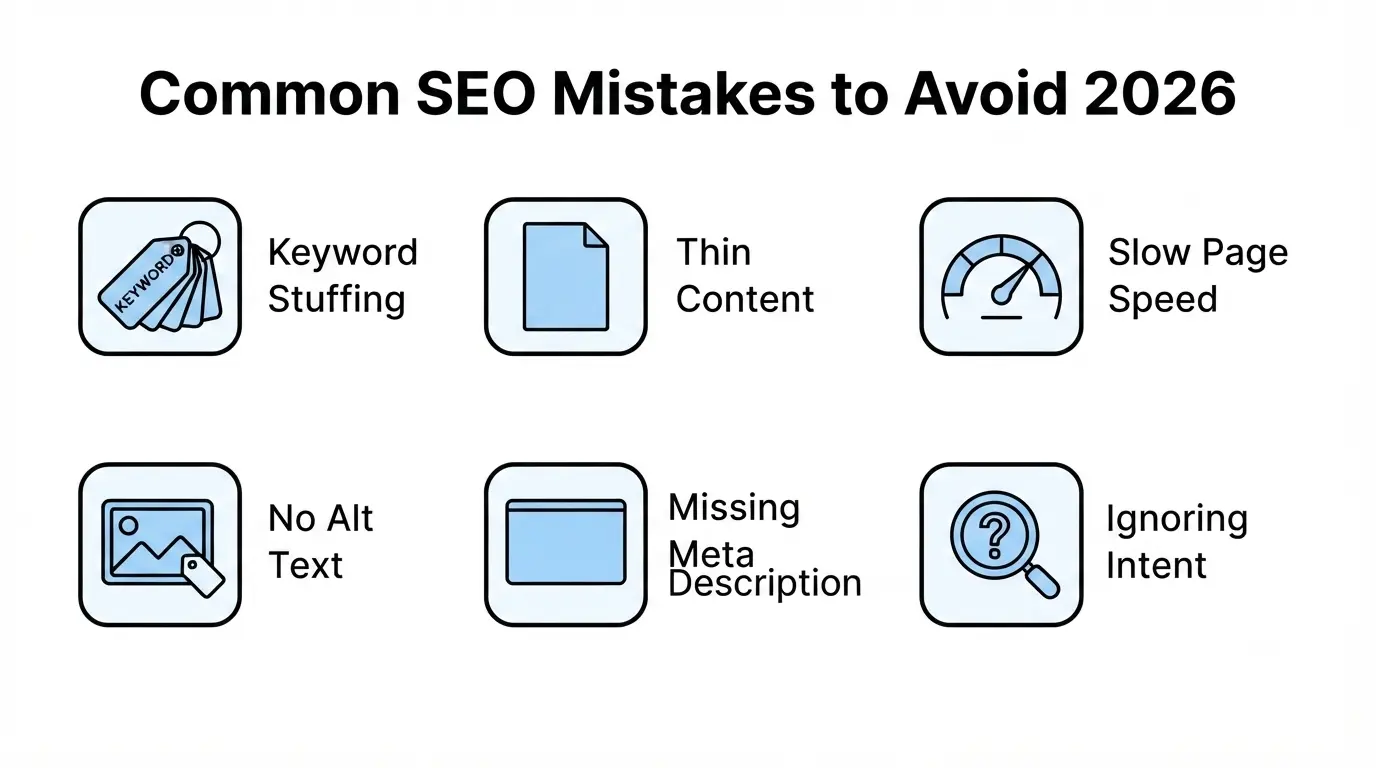
Common SEO Mistakes to Avoid: The Ones Worth Watching First
1. Targeting Too Many Keywords in One Post
It’s tempting to try and rank for five related terms with a single page, especially when you’re short on time. But spreading one post across too many keywords usually means it doesn’t rank well for any of them, because the content ends up unfocused.
Fix it by: Picking one clear focus keyword per post, and if you have other related terms worth targeting, giving each one its own dedicated page instead.
2. Ignoring Search Intent Completely
You can have the right keyword and still miss the mark if your content doesn’t match what people actually want when they search it. A comparison post won’t rank well if searchers are actually looking for a step-by-step tutorial.
Fix it by: Searching your target keyword yourself before writing, and paying attention to whether the top results are guides, comparisons, or product pages, then matching that format.
3. Publishing Thin or Rushed Content
Posting frequently sounds like a good strategy until the content itself becomes an afterthought. A 300-word post that barely scratches the surface rarely outranks a competitor who actually answered the question properly.
Fix it by: slowing down and covering a topic properly, even if that means publishing less often. A handful of genuinely useful posts will outperform a pile of rushed ones almost every time.
4. Forgetting to Set a Meta Description
Leave the meta description blank, and Google will pull a random snippet from your page instead, which is rarely as compelling as something you’d write on purpose. This is one of those small things that’s easy to skip and easy to fix.
Fix it by: Writing a clear, specific meta description under 155 characters for every page, one that actually gives someone a reason to click your result over the one above or below it.
5. Stuffing Keywords Unnaturally
This mistake goes back further than most people realise, and somehow it’s still around. Repeating your keyword every other sentence doesn’t help rankings anymore; it just makes content harder to read and more likely to get skipped.
Fix it by: Using your keyword naturally where it fits, aiming for it to show up a handful of times across the whole post rather than forcing it into every paragraph.
6. Neglecting Page Speed and Mobile Experience
A slow-loading site or one that looks broken on a phone loses visitors before they even see your content, no matter how good that content is. Most searches happen on mobile now, so this isn’t a minor detail anymore.
Fix it by: Testing your site on your own phone regularly, compressing large images, and running a free speed check with a tool like Google PageSpeed Insights every so often.
7. Skipping Internal Links
Every post that goes live without linking to anything else on your site is a missed opportunity. Internal links help search engines discover your other content, and they keep readers exploring instead of leaving after one page.
Fix it by: linking to at least one or two related posts on your own site whenever it fits naturally, using descriptive anchor text instead of “click here”.
8. Leaving Images Without Alt Text
Images without alt text are a missed opportunity twice over, once for accessibility, since screen readers rely on it, and once for SEO, since it helps search engines understand what the image actually shows.
Fix it by: Writing a short, honest description of every image you upload, working your keyword in naturally where it actually applies rather than stuffing it into every single one.
9. Chasing Every New SEO Trend
SEO advice changes constantly, and it’s easy to feel like you need to overhaul your whole strategy every time a new update or trend gets talked about. Most of the time, that instinct does more harm than good.
Fix it by: Sticking to the fundamentals, helpful content, solid structure, decent site speed, and a few good backlinks, rather than chasing every shiny new tactic that shows up online.
10. Never Checking What’s Actually Working
Publishing content and never looking back is one of the quietest mistakes out there, because it means you keep repeating whatever isn’t working without realising it.
Fix it by: Checking your rankings and traffic every month or two, noticing which posts are actually pulling their weight, and updating older content that’s slipped instead of only focusing on new posts.
Common SEO Mistakes: Quick Checklist
Here’s a quick recap of the common SEO mistakes to avoid that we’ve covered in this guide:
- Target one focus keyword per post, not several
- Match your content format to actual search intent
- Write thorough content instead of rushing to publish often
- Set a proper meta description for every page
- Use your keyword naturally, not repeatedly
- Keep your site fast and mobile-friendly
- Add internal links to related posts
- Write real alt text for every image
- Stick to SEO fundamentals over chasing trends
- Review your rankings and update old content regularly
Also read: On-Page vs Off-Page SEO: Complete Guide 2026
Also read: How to Do Keyword Research for Free in 2026
The Bottom Line
None of these common SEO mistakes to avoid are dramatic on their own. That’s exactly what makes them easy to overlook, they’re small enough to slide by unnoticed while quietly holding your rankings back month after month.
Go through this list against your own site honestly. You probably won’t find all ten, but even fixing two or three of them can make a real difference over the next few months.
Not sure where your site stands? AmanTPoint can run through your website and flag exactly what’s holding your SEO back.


