Google AI marketing tools now form one of the largest AI-powered marketing ecosystems in the world. From writing content to running ads, tracking analytics, and even generating product photos, there is a Google AI tool for nearly every step of the marketing process.
If you are a business owner, marketer, or freelancer, understanding these Google AI marketing tools can save you both time and money. This guide breaks down 20+ tools across 8 categories, so you know exactly which one to use and when. For a deeper look at how Google ranks websites, see our top 10 SEO ranking factors guide.
Best Google AI Marketing Tools to Start With (5 Free Tools)
Before spending on any paid tool, master these five free ones. Together they cover research, content, tracking, and reporting — everything a beginner needs.
- Google Search Console — free, tracks your search rankings and indexing
- Google Analytics 4 is free and tracks website traffic and user behaviour
- Gemini AI — free, helps with writing and research
- Google Trends — free, shows what people are searching for
- Looker Studio — free, builds visual marketing reports
1. AI Core & Brain Tools
These are Google’s flagship AI models and the search intelligence layer that now shapes how people find information online.
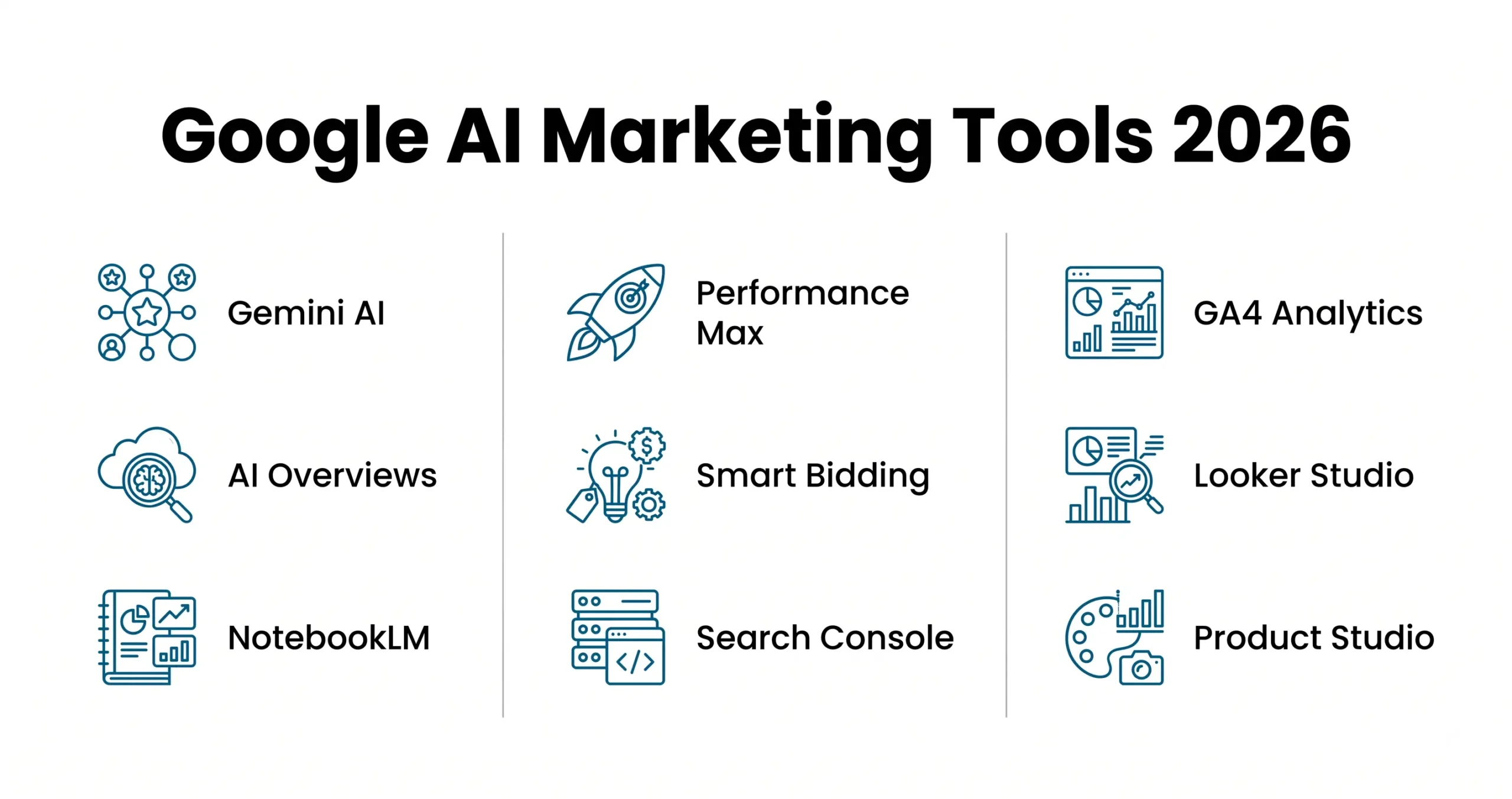
Google Gemini (Free + Paid) helps with writing, research, content ideas, analysis, and answering questions. Gemini 2.5 Pro (Paid) handles advanced reasoning and long-form content, supporting up to 1 million tokens for deep analysis. Google AI Overviews (Free) generates AI summaries directly in search results, making it critical to understand for modern SEO. Google AI Mode (Free) offers reasoning-based search for complex, multi-part queries. NotebookLM (Free) is useful for research summarisation, content analysis, and even generating podcast-style audio from your documents.
2. Advertising & Campaign: Google AI Marketing Tools
This category is all about AI-powered ad automation and targeting, designed to reduce manual campaign management.
Performance Max (PMax) automatically distributes ads across Search, YouTube, Gmail, Maps, and Display from a single campaign. AI Max for Search runs advanced multi-modal search campaigns aimed at maximising ROI. Demand gen campaigns push visual ads across YouTube, Discover, and Gmail to build demand. Google Smart Bidding automatically sets the best bids for conversions and ROAS. Responsive Search Ads let AI pick the best-performing headline and description combinations on its own. Ads in AI Overviews is Google’s newer format that places brand ads directly inside AI-generated search answers. All of these tools are paid.
3. Analytics & Data Tools
Tracking and measuring performance is the backbone of any marketing strategy, and Google offers tools for every level of complexity.
Google Analytics 4 (GA4) (Free) tracks website traffic, user behaviour, conversions, and predictive insights. Google Trends (free) shows what the world is searching for, useful for content ideas and seasonal planning. Google Looker Studio (Free) turns raw data into visual dashboards and automated reports. For larger operations, BigQuery ML (paid) enables advanced AI data modelling at enterprise scale, Google Meridian (paid) handles marketing mix modelling to show which channel delivers the best ROI, and Google Attribution (free + paid) credits conversions across all your marketing touchpoints.
4. Content & Creative Tools
This is where Google’s generative AI shows up most visibly — producing images, video, and written content for campaigns.
Gemini (Free + Paid) writes blog posts, ad copy, social captions, and email campaigns. Imagen 4 (Paid) generates high-quality AI images for ads and marketing visuals. Veo (Paid) creates AI-generated video content for campaigns, while Google Flow (Paid) offers a more advanced AI creative video production suite. Google Vids (Workspace) converts documents and briefs into marketing videos automatically. Google Product Studio (Free) enhances product photos specifically for e-commerce ads.
5. SEO & Search Tools
These free tools form the foundation of any serious SEO strategy and pair well with the top 10 SEO ranking factors that determine where your site lands in search results.
Google Search Console tracks keyword rankings, impressions, click-through rate, and indexing errors. Google Keyword Planner handles keyword research, including search volume, competition, and CPC data. Google PageSpeed Insights analyses your site speed score and Core Web Vitals. Google Rich Results Test validates your Schema.org structured data markup. Google Business Profile AI supports local SEO optimisation, reviews, and map presence. All five of these tools are completely free.
6. Google Workspace AI
For teams already using Gmail, Docs, and Sheets, Gemini is now built directly into the Workspace suite.
Gemini in Gmail drafts email campaigns, summarises threads, and suggests smart replies. Gemini in Google Docs helps write articles, blog posts, and marketing copy. Gemini in Google Sheets analyses campaign data, builds reports, and automates formulas. Gemini in Google Slides auto-generates marketing presentations and pitch decks. Gemini in Google Meet offers live translation, meeting summaries, and action items. All of these require a Workspace subscription.
7. E-Commerce Marketing Tools
Online sellers get their own dedicated set of AI tools built around Google Shopping.
Google Merchant Center (Free) uploads your products to Google Shopping listings. Google Shopping Ads (Paid) creates AI-optimised product ads with images and prices. Performance Max for Retail (Paid) automates e-commerce-specific ad campaigns. Google Product Studio (Free) uses AI to enhance product photos for better conversion rates.
2026 Strategy Tip
Google’s algorithm in 2026 prioritises what it calls “AI Excellence” — content that is insightful, user-centric, and enhanced with human oversight. Rather than jumping straight into paid Google AI marketing tools, start with the five free ones: Search Console, GA4, Gemini, Trends, and Looker Studio. Master these first, since this combination alone can give you powerful, data-driven digital marketing without spending anything.
Key Takeaway on Google AI Marketing Tools
Google’s AI marketing tools now cover nearly every stage of a campaign — research, content creation, advertising, analytics, and reporting. You do not need all 20+ tools at once. Start free, understand what each tool actually does, and add paid tools only when a genuine gap in your workflow demands it.


