
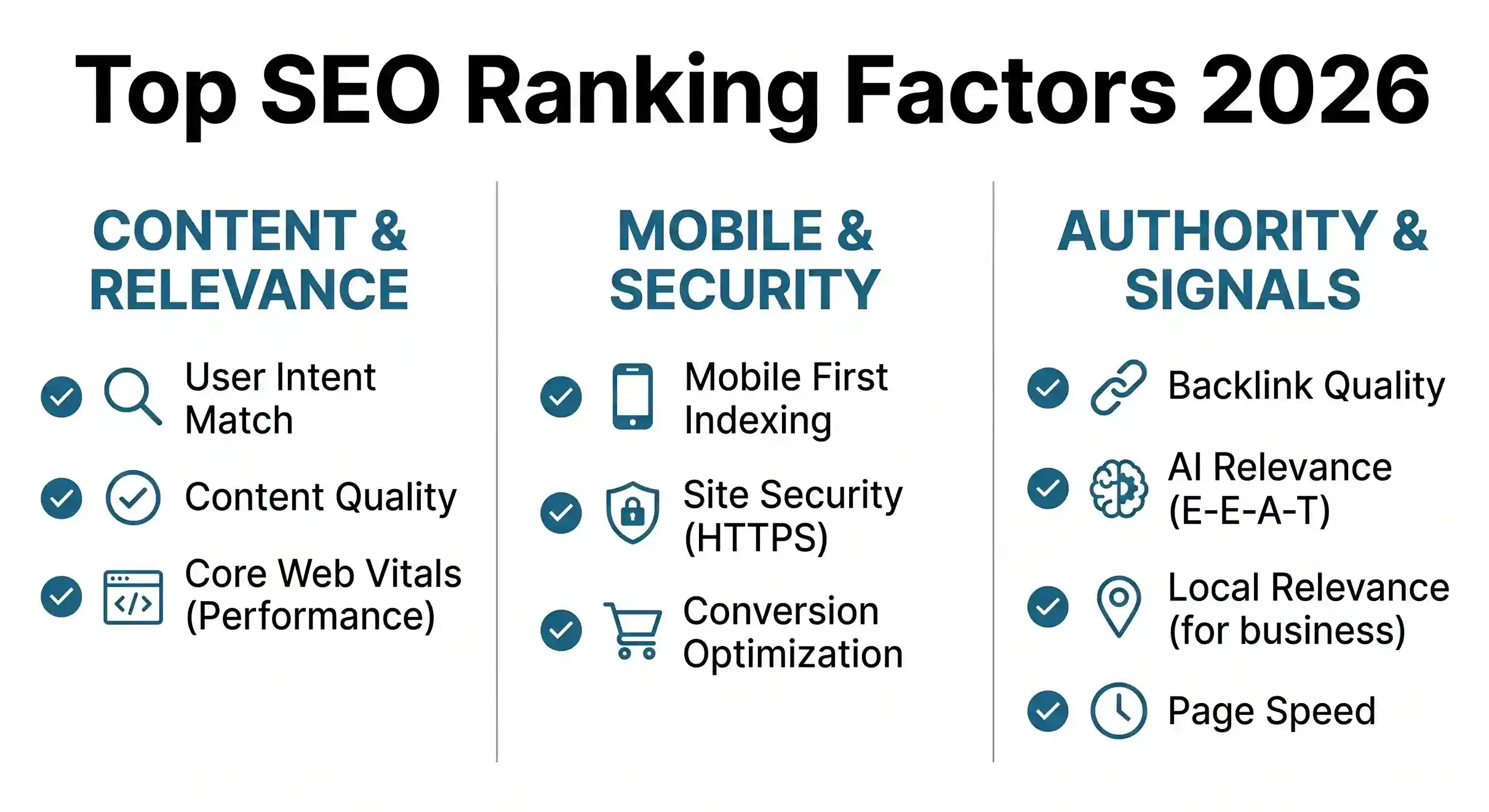
Google looks at hundreds of signals before deciding where your website lands in search results, but not all of them carry equal weight. If you’re running a business website and want more organic traffic, understanding the top 10 SEO ranking factors can help you focus on the areas that matter most.
Instead of trying to chase every possible ranking signal, businesses should focus on creating useful content, improving website performance, building trust, and making their websites easy for both users and search engines to understand. Here are the top 10 SEO ranking factors that matter most in 2026.
The foundation of SEO is still helpful, unique content. Google favours pages that genuinely address the searcher’s query instead of pages filled with repetitive, superficial, or keyword-stuffed information.
How to proceed: Write for the person searching rather than simply writing for an algorithm. Cover the topic thoroughly, answer relevant questions, provide useful examples, and update older content when information changes.
2. Page Experience & Core Web Vitals
Website performance plays an important role in providing a good user experience. Pages that load slowly or feel unstable can frustrate visitors and may reduce conversions.
What to do: Compress images, use reliable hosting, reduce unnecessary scripts, and improve your Core Web Vitals. You can check your website performance using it.
3. Mobile Usability
Mobile usability is one of the most important areas to consider when working on the top 10 SEO ranking factors. A large number of searches happen on mobile devices, so your website needs to work properly on smaller screens.
What to do: Make sure text is easy to read, buttons are simple to tap, images fit correctly, navigation works smoothly, and no content overlaps or breaks on mobile devices.
4. E-E-A-T: Experience, Expertise, Authoritativeness and Trustworthiness
E-E-A-T stands for experience, expertise, authoritativeness, and trustworthiness. Demonstrating genuine knowledge and experience can help users understand why they should trust your content and business.
What to do: Show who created your content, demonstrate relevant experience, maintain an updated About page, provide accurate business information, and be transparent about your organisation.
5. Backlinks from Authoritative Websites
When reputable websites link to your content, those links can help search engines understand that your website is useful and credible. Quality is more important than simply collecting a large number of backlinks.
What to do: Earn links from relevant industry websites, local organisations, trusted directories, publications, and useful resources. Create original content that other websites have a genuine reason to reference.
6. Search Intent Match
Using the right keyword is not enough. Your page also needs to satisfy the reason behind the search. For example, someone searching for “best pizza near me” is usually looking for local restaurants rather than an article about the history of pizza.
What to do: Search your target keyword before creating a page. Study the type of content appearing in the results and make sure your page provides a better and more useful answer to the same search intent.
7. Technical Crawlability and SEO
Search engines need to be able to crawl, understand, and index your website. Technical problems such as broken links, duplicate pages, poor website structure, or incorrectly configured indexing can make it harder for search engines to discover important content.
What to do: Keep your XML sitemap updated, fix broken links, use clean URLs, improve your internal linking structure, and make sure important pages are not accidentally blocked from indexing.
For more useful digital marketing and SEO resources, you can also explore Google AI and digital marketing tools to improve your website’s online performance.
8. HTTPS and Website Security
A secure HTTPS website is a basic requirement for modern websites. SSL encryption protects information transferred between the visitor and the website and helps provide a safer browsing experience.
What to do: Make sure your SSL certificate is valid, your website loads using HTTPS, and there are no mixed-content warnings or insecure resources.
9. Local SEO Signals
For businesses serving a specific location, local SEO can be extremely important. Google Business Profile optimisation, genuine customer reviews, consistent business information, and relevant local signals can help businesses appear in local search results.
What to do: Keep your Google Business Profile complete and active, collect genuine customer reviews, use consistent business information across directories, and create useful location-specific content.
10. User Engagement and Content Satisfaction
A successful SEO page should satisfy the visitor’s needs. Clear structure, readable content, useful visuals, and easy navigation can encourage visitors to interact with your website instead of immediately returning to the search results.
What to do: Avoid unnecessary padding just to increase word count. Use descriptive headings, short paragraphs, relevant images, helpful examples, and clear calls to action.
The Key Takeaway
There is no single trick that guarantees a top position in Google. However, focusing on the top 10 SEO ranking factors can give your website a strong SEO foundation.
Start with a technically sound, secure, and mobile-friendly website. Then publish genuinely helpful content, satisfy search intent, demonstrate expertise, build quality backlinks, and strengthen your internal linking. These fundamentals can help your website build stronger organic visibility over time.
SEO is a long-term process. Rather than chasing every new SEO trend, focus on creating a website that is useful, trustworthy, technically accessible, and genuinely valuable to your audience.


