
On-page vs off-page SEO — one of the first things any website owner should learn before attempting to rank on Google is this exact difference. You are aware of what Google considers when rating a website if you have already read our tutorial on the top 10 SEO ranking factors. The next obvious question is, “How do you actually work on these factors?” On-page and off-page SEO are useful in this situation.
Although they operate in quite distinct ways, these two sections together cover nearly everything required to score better. AmanTPoint lays down both forms of SEO, explains where to concentrate first, and provides a straightforward checklist that you can use right now on your own website.
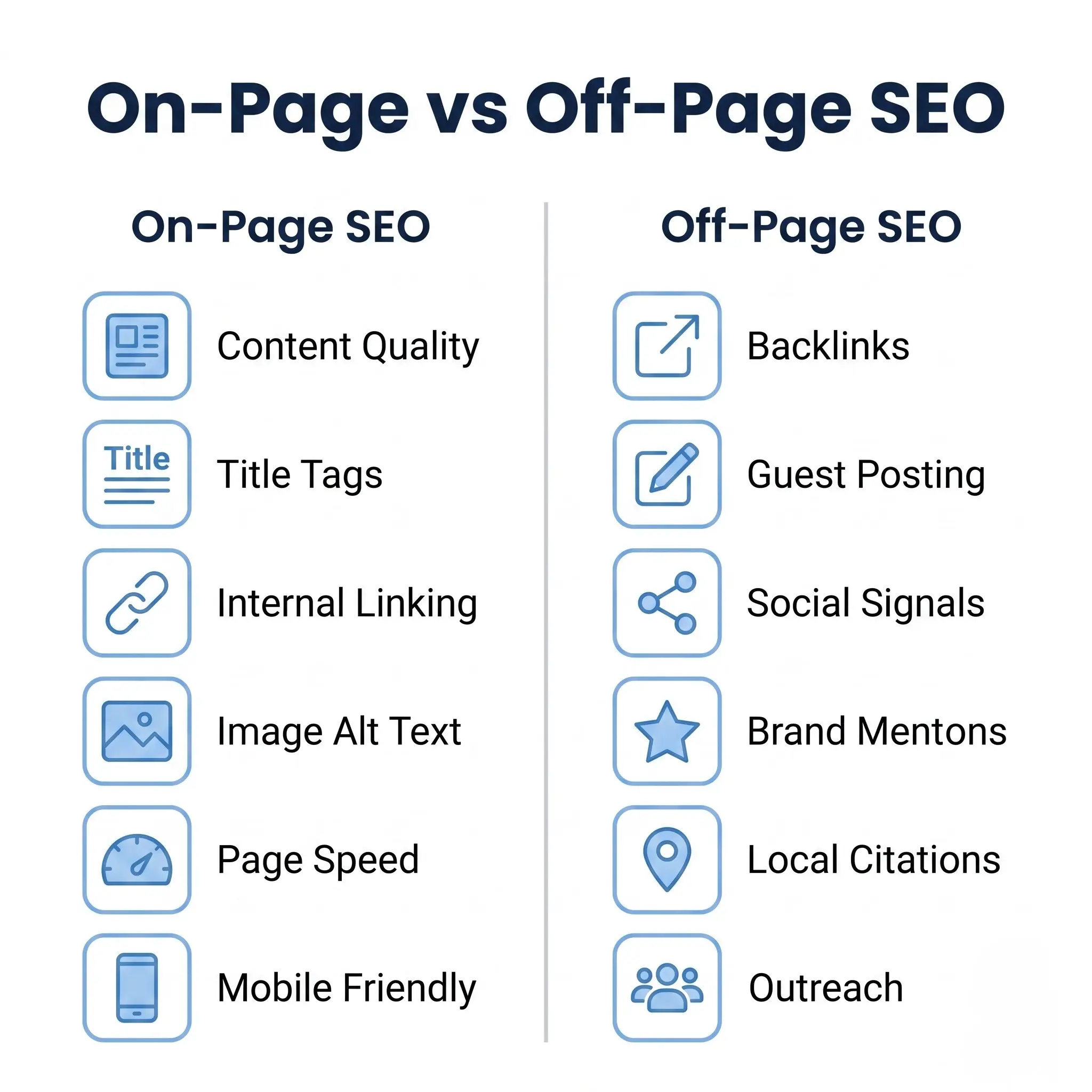
What Is On-Page SEO Compared to Off-Page SEO?
Everything you optimise directly on your own website to aid search engines in comprehending and ranking your content is referred to as “on-page SEO”. This is the ideal starting point for novices because you have complete control over these components. One of the best signs search engines use to comprehend a page is well-structured on-page content.
1. Meta Descriptions and Title Tags
Your title tag is frequently the first thing a searcher sees in the results, and it has a significant impact on both click-through rate and search engine relevancy signals.
How to proceed: Put your main keyword close to the start of your title tag and keep it under 60 characters. Write a concise, attention-grabbing meta description that entices readers to click in less than 155 characters.
2. Content Structure and Header Tags
H1, H2, and H3 tags on a well-structured page make it easier for users and search engines to swiftly scan your content and comprehend how the material is arranged.
What to do: Make your main title a single H1 and divide the remainder of the text into logical H2 and H3 sections that flow naturally from the theme.
3. Search Intent and Content Quality
In 2026, information that is thin or redundant seldom scores well. In addition to having the appropriate keywords, your page must really address the searcher’s query.
What to do: To ensure that your material provides a more comprehensive or helpful response, thoroughly cover the subject, respond to pertinent queries, and examine already-existing top-ranking sites before writing.
4. Internal Connectivity
Internal links allow users to stay on your website longer while also assisting search engines in finding material and distributing authority throughout it.
What to do: Instead of using generic phrases like “click here”, use descriptive anchor text to naturally link to similar sites within your content.
5. Image Enhancement
Images enhance the user experience, yet poorly optimised images might degrade your website’s speed and rankings.
What to do: To ensure that photos load quickly without sacrificing quality, use descriptive file names, add pertinent alt text, and compress images.
6. URL Organization
Both visitors and search engines can quickly understand clear, readable URLs.
What to do: Instead of using lengthy, automatically produced strings, keep URLs brief and keyword-relevant, such as /on-page-vs-off-page-seo/.
What Is Off-Page SEO Compared to On-Page SEO?
Everything that takes place outside of your website but still affects how users and search engines see your reputation is covered by off-page SEO. Backlinks are the main component of off-page SEO, but there is more to it.
7. Backlinks from Reputable Websites
Reputable websites that link to your material serve as votes of confidence, indicating to search engines that your website is reliable and helpful.
What to do: Rather than merely pursuing a large quantity of low-quality connections, concentrate on obtaining links from pertinent industry websites, directories, and magazines.
8. Posting as a Guest
A natural strategy to get backlinks and expand your audience is to write content for other reputable websites in your area.
What to do: Get in touch with media and blogs that are pertinent and have ideas for truly helpful content. When appropriate, offer a natural link back to your website.
9. Brand Mentions and Social Signals
Although they don’t directly improve rankings, social media shares, mentions, and engagement can indirectly increase visibility, traffic, and brand trust.
What to do: Instead of depending on phoney shares or mentions, post your material often across pertinent sites and promote real interaction.
10. Local References and Evaluations
Consistent company listings and sincere client testimonials boost local search visibility and trust for companies operating in a particular area.
What to do: Make sure your company’s name, address, and phone number are the same in all directories, and actively seek out positive evaluations from pleased clients.
Off-Page vs. On-Page SEO: Important Distinctions
| Factor | On-Page SEO | Off-Page SEO |
|---|---|---|
| Where it takes place | On your personal webpage | Beyond your website |
| Control level | Complete control | Restricted/indirect control |
| Main focus | Content, organization, and technical setup | Reputation, authority, and trust |
| Examples | Headers, text, internal links, and title tags | Social media mentions, guest posts, and backlinks |
| Time to see results | Generally faster | Slower, but gradually increasing |
Which Should You Prioritise First?
On-page SEO should be prioritised for the majority of websites. Building backlinks to a page that is slow, poorly organised, or doesn’t truly address the searcher’s query is pointless. Off-page initiatives like outreach and link building will yield much greater results once your on-page foundation is strong.
To put it simply, off-page SEO explains to Google why it should trust and rank your page higher than others, while on-page SEO explains what your page is about.
Quick Checklist for On-Page and Off-Page SEO
- Make every page’s title tags and meta descriptions more effective
- Use a single, logical H2/H3 structure and a clear H1
- Write comprehensive information that completely addresses search intent
- Include internal links to pertinent pages that already exist
- Reduce the size of photos and speed up page loads
- Create backlinks from reputable, pertinent domains
- Maintain consistency in your citations and Google Business Profile
- Monitor keyword rankings and make content adjustments over time
If you’re just getting started, our guide on the top 20 truly free SEO tools contains everything you need to audit your pages, conduct keyword research, and monitor your on-page and off-page development without having to pay a dime.
The Crucial Lesson
Off-page and on-page SEO are two parts of the same development engine, not opposing tactics. You will know exactly where to focus your efforts if you have a strong understanding of on-page vs off-page SEO. Prioritise getting your on-page fundamentals correct before adding off-page authority building.
The process of SEO takes time. Your organic rankings in 2026 will be a reflection of your consistent efforts to maintain genuinely relevant content.
Do you need assistance implementing this? The AmanTPoint team works with companies to establish more robust on-page foundations and long-lasting off-page authority so that your website increases organic visibility in the proper manner.


